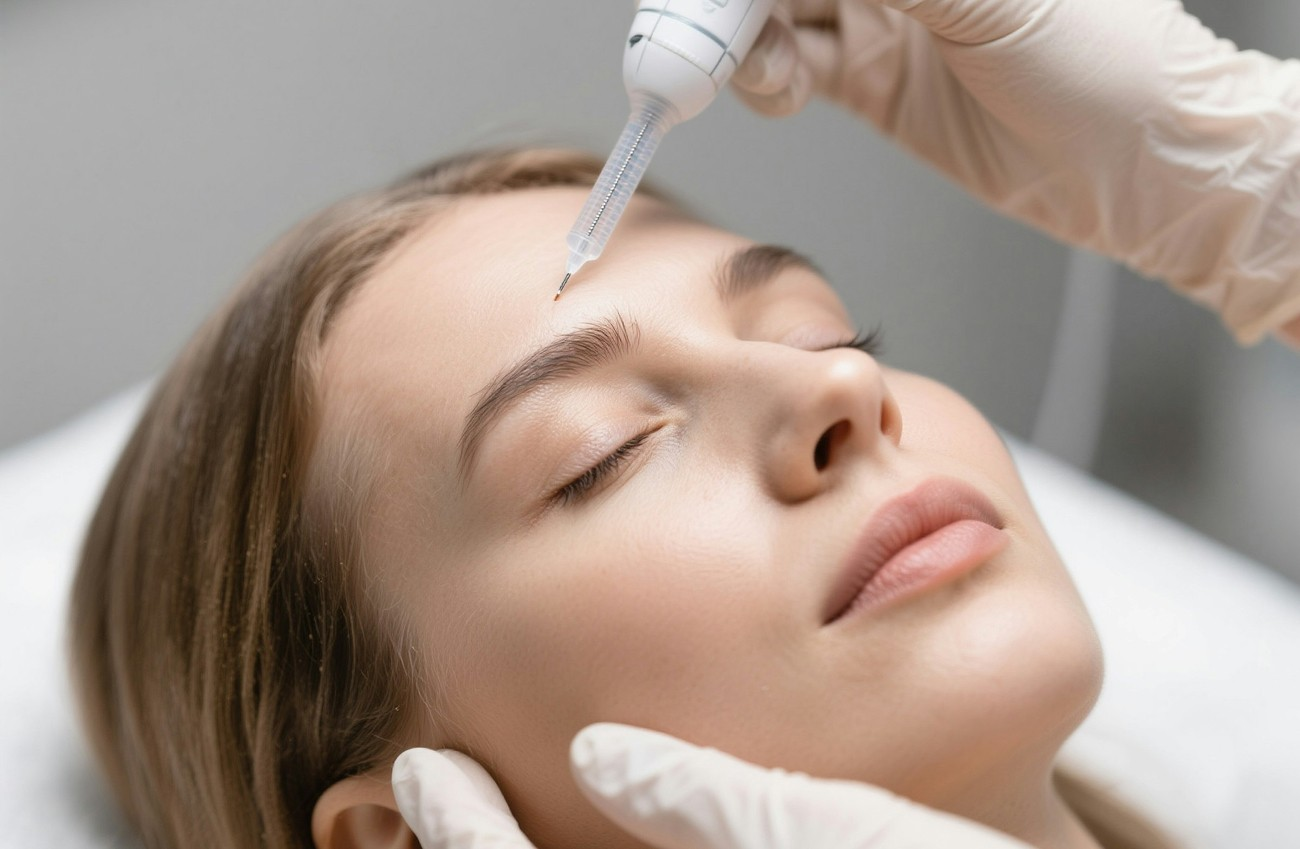
Why indented acne scars need MNRF and subcision rather than surface creams
Why atrophic acne scars respond to procedures such as microneedling RF and subcision, and why creams alone rarely change their depth.

Why topical creams cannot release tethered scar tissue
Topical retinoids, azelaic acid and sunscreen are helpful for fading flat red or brown marks left after a pimple heals. True indented (atrophic) acne scars, however, sit deeper in the dermis where collagen was lost during inflammation and fibrous bands pull the skin downward.
Because creams cannot physically sever fibrous tethers or rebuild deep dermal architecture, treating indented scars almost always requires procedural dermatology.
1. Identifying rolling, boxcar and ice-pick scars
Most patients have a mix of scar types on the same cheek, which is why examining the skin under angled clinical lighting comes first:
- Rolling scars: broad, wave-like depressions anchored to deeper tissue by fibrous bands.
- Boxcar scars: wider depressions with sharper vertical edges and a flat base.
- Ice-pick scars: narrow, V-shaped pinpoint pits extending deep into the dermis.
2. How subcision releases fibrous bands beneath the skin
For tethered rolling scars, subcision is often the essential first step. Under local anaesthetic, a specialised cannula or needle is passed horizontally beneath the scar to release the fibrous strands pulling the surface down, allowing the depressed skin to lift and new collagen to form in the space created.
3. Remodelling dermal collagen with MNRF and fractional CO2 laser
Once tethered scars are released, energy-based resurfacing stimulates dermal remodelling across a series of spaced sessions:
- Microneedling Radiofrequency (MNRF): insulated microneedles deliver controlled heat directly into the dermis while sparing the pigment-rich epidermis, making it a versatile choice for Indian skin tones with shorter recovery.
- Fractional CO2 laser: creates microscopic thermal columns to remodel deeper boxcar scars and uneven texture, requiring stricter sun protection and several days of crusting recovery.
- Biostimulatory adjuncts: PRP or GFC may be combined with microneedling or subcision to support tissue healing.
"Acne scar revision is a staged journey. Combining subcision with MNRF or fractional laser over several months achieves far more natural improvement than relying on a single modality."— Dr. Darshana (Consultant Dermatologist)
4. Setting realistic expectations
Collagen matures slowly over 8 to 12 weeks after each session. Most treatment plans involve 3 to 6 sessions spaced 4 to 6 weeks apart, aiming for a meaningful softening of scar depth and smoother skin texture rather than total erasure.
Book a digital skin barrier assessment
Consult Dr. Darshana for a dermoscopic analysis and bespoke medical skincare blueprint.

More from the Skin Journal
A dermatologist’s guide to repairing a damaged skin barrier on Indian skin

Collagen banking in your 30s: when to introduce retinoids, peptides and Profhilo